
The goal of this lesson is to understand what budgeting is and how planning your spending in advance works.
Budgeting
Ever reach the end of the month and wonder where all your money went?
Budgeting is a tool to prevent that stress. In simple terms, budgeting means planning your spending before you spend.
Instead of just tracking money after it’s gone, you decide in advance exactly how to use each dollar (or any other currency) of your income. Think of it as giving every dollar a specific job to do, before it leaves your wallet or account.
What does a budget look like?
You start by listing your expected income and your expense categories (for example: rent, groceries, transport, and fun). Then you assign a fixed amount of money to each category ahead of time.
Let’s say you earn $2000 this month – you might decide $700 goes to rent, $300 to groceries, $100 to transport, $100 to a fun activity, and so on.
You keep allocating money to categories until you’ve assigned the whole $2000.
This way, every dollar is accounted for with a purpose.
This approach is often summed up as “every dollar has a job.” Nothing is left idle or unaccounted for in your plan.
If you picture your money as workers, you’re telling each one what task it should accomplish (rent, savings, etc.) before the work (spending) begins.
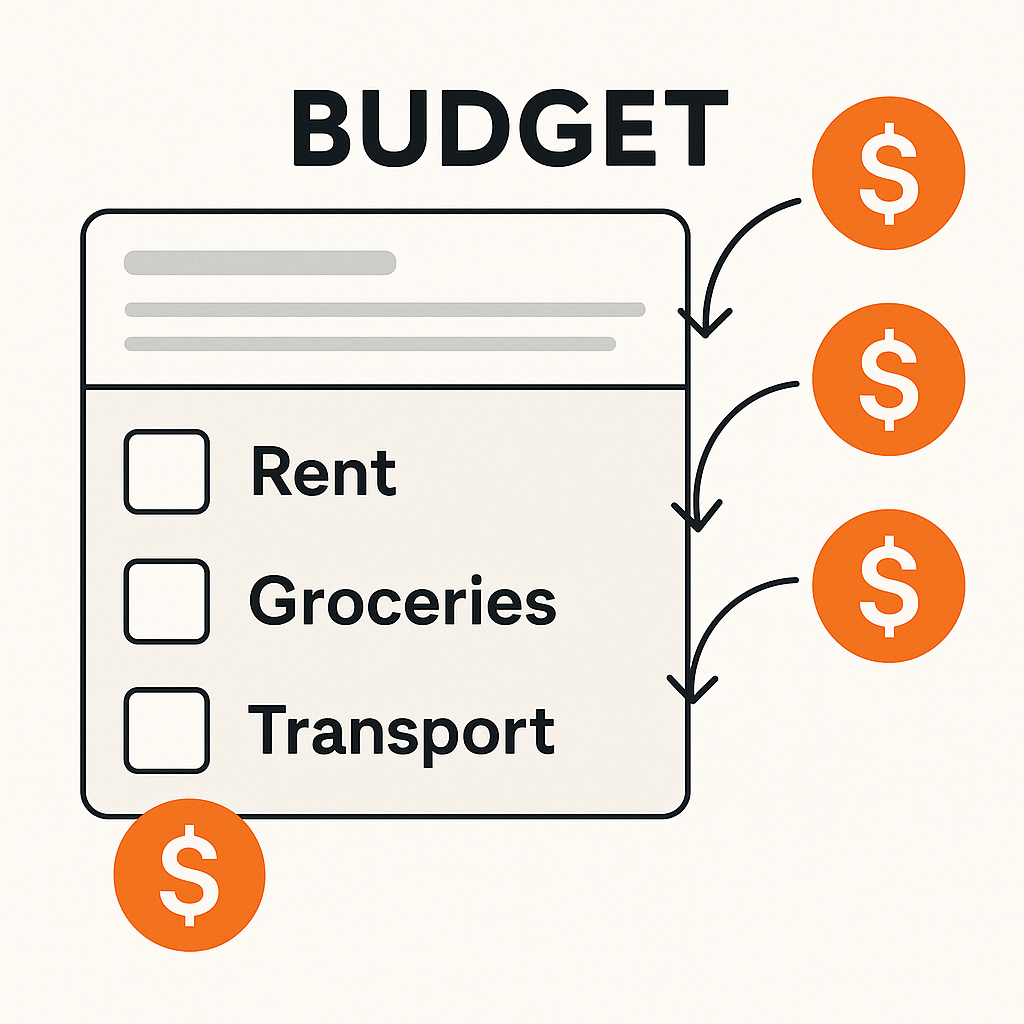
Budgeting is proactive.
For example, if you know a big bill is coming, you plan for it in your budget by reserving money in that category.
This is different from simply checking your balance and hoping there’s enough – you’re taking control ahead of time.
By setting category caps (limits for each spending category), you also create gentle guardrails.
If you budget $300 for groceries, that’s a friendly reminder to adjust your shopping if you approach that limit, so you don’t accidentally overspend and shortchange another area.
The beauty of budgeting is the clarity it brings.
With a budget, you can see exactly where your money is supposed to go.
Many people find this reduces financial anxiety. Instead of feeling unsure if you can afford something, you’ll know because you already planned for it (or see that you didn’t). Budgeting gives you a roadmap for your month: you can still enjoy your money, but with the confidence that the important things are covered.
It’s not about perfection or penny-pinching every cent – it’s about being intentional and telling your money what you want it to do, before it slips away.
Practical takeaway:
- Decide on a spending plan before the month starts.
- Allocate your entire income into categories until every dollar is assigned.
- Set realistic spending limits for each category as gentle guardrails.
- Give every dollar a job – don’t leave any money idle.